Revitalize Your Well-being: Safe, Effective Homeopathic Treatments for All Ages

From Fragility to Function: The Biochemistry of Nervous Exhaustion
Nervous exhaustion isn’t a flaw in character — it’s a depletion of nerve tissue. Rooted in Schuessler’s biochemic theory, this article explains how Kali Phos supports the brain’s grey matter and neural resilience. When depleted, burnout and mental fatigue follow. Restoration begins by rebuilding the nervous system at its mineral core.
ARTICLE
Dr. R S Saini
3/3/20262 min read

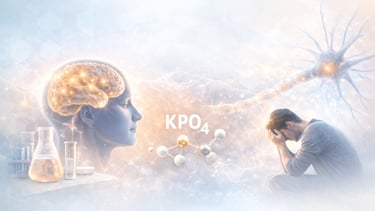
Kali Phos (Potassium Phosphate). I focused on:
• Sharpening clarity, flow, and scientific tone while staying true to Schuessler’s biochemic principles (drawing from his original concepts of nerve tissue formation via albumen + oxygen + the salt).
• Strengthening the biochemical vs. personality distinction with precise language.
• Improving readability: tighter sentences, consistent bullet formatting, logical progression, and emphatic repetition where it drives the point home.
• Preserving the respectful, empowering message exhaustion as a legitimate tissue depletion, not weakness.
KALI PHOS :
WHY “NERVOUS EXHAUSTION” IS OFTEN A BIOCHEMICAL FAILURE, NOT JUST A PERSONALITY TRAIT
Dr. Wilhelm Heinrich Schuessler was unequivocal: Kali Phos (Potassium Phosphate) is the primary inorganic cell-salt responsible for building and maintaining nerve substance, especially the grey matter of the brain.
His foundational statement captures it clearly:
“The grey matter of the brain is controlled entirely by the inorganic cell salt Potassium phosphate. This salt unites with albumen, and by the addition of oxygen creates nerve-fluid, or the grey matter of the brain.”
The biochemical mechanism
Nerve tissue is constructed from protein (albumen), oxygen, and this key mineral salt. Kali Phos enables the precise assembly and regeneration of nerve cells.
When Kali Phos is sufficient:
• Albumen integrates properly into stable nerve structures.
• Oxygen utilization is efficient.
• Nerve fluid and grey matter are continuously formed and replenished.
• Neural signals transmit smoothly, calmly, and resiliently.
When Kali Phos is deficient:
• Nerve tissue cannot rebuild or repair adequately.
• Oxygen handling falters.
• Metabolic waste from fatigue accumulates.
• Nerves become fragile, over-reactive, and “highly strung.”
This is not mere overstimulation or emotional sensitivity.
It is a structural biochemical failure—depletion of the actual material substrate of the nervous system—often triggered by prolonged high demands: intense stress, exams, heavy workloads, caregiving, grief, or the relentless pace of modern life.
Why exhaustion manifests as “mental” symptoms
Schuessler emphasized that symptoms arise because the nerve tissue itself is exhausted and depleted—not because the person is inherently weak, overly sensitive, or “fragile.”
Classic signs of Kali Phos deficiency include:
• Profound mental fatigue and brain fog
• Irritability alternating with apathy
• Anxiety, fearfulness, or low mood
• Poor memory and concentration
• Insomnia or restless sleep
• Nervous digestion (e.g., “butterflies,” indigestion from stress)
• Loss of drive, motivation, or inner “spark”
• Dull, expressionless eyes and face
• An overall unkempt or “drained” appearance (even if hygiene is maintained)
Nothing else can substitute: no other nutrient, vitamin, or remedy rebuilds this specific tissue foundation.
Schuessler stated it directly:
“When nervous symptoms arise due to the fact that the nerve tissue has been exhausted from any cause, the Phosphate of Potassium is the only true remedy, because nothing else can possibly supply the deficiency.”
This is a structural claim, not a psychological one.
Clinical relevance today
Kali Phos is not a sedative or suppressant—it does not artificially calm nerves by dulling them.
It acts as a true nerve nutrient, restoring the depleted material basis of nerve tissue and allowing natural function to return.
This is why it repeatedly proves invaluable in cases of:
• Chronic or acute stress overload
• Burnout from prolonged pressure
• Grief, emotional shock, or overwork
• Convalescence after illness or surgery
• Long-term anxiety or emotional exhaustion
The individual is not “emotionally fragile.”
They are biochemically depleted at the level of nerve cells.
Kali Phos does not numb—it reconstructs.
That distinction lies at the heart of the biochemic approach: nervous exhaustion is not a character flaw.
It is a mineral-tissue imbalance that, when addressed at its root, restores clarity, resilience, and vitality.
This perspective empowers rather than pathologizesturning “Why am I like this?” into “What does my nervous system need to rebuild?”
Natural Homeopathic Solutions © 2025. All rights reserved.

Subscribe to our newsletter
This website is built & managed by Mverse360